
Gambling Apps With Cash Out Feature UK
 Available in GB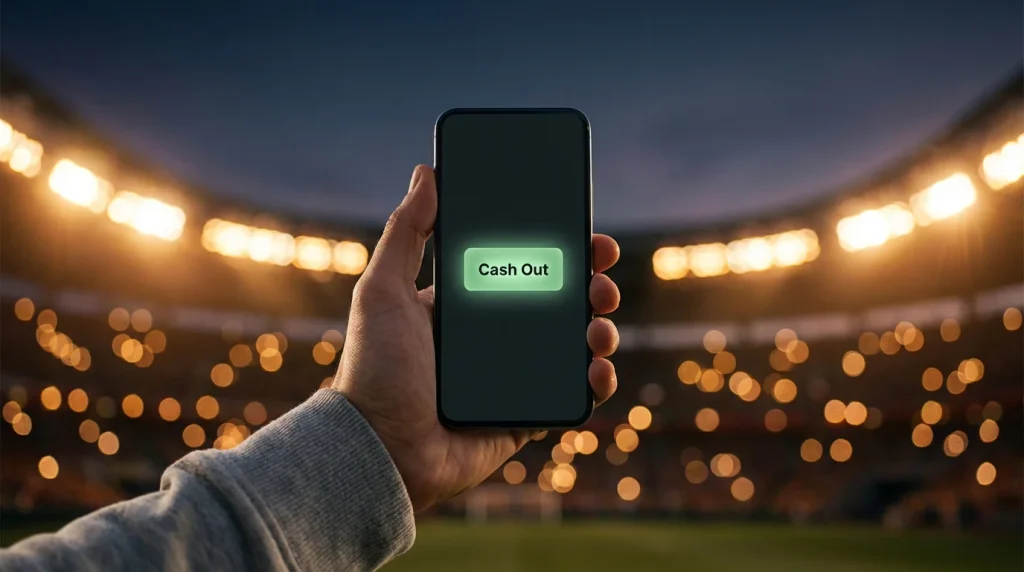
Cash out gives you control over timing — but the price of that control is built into every offer. Before cash out existed as a mainstream feature on UK betting apps, a placed bet was a commitment. You chose your selection, set your stake, and waited for the event to conclude. The only exit was selling your bet to another person or, in rare cases, phoning the bookmaker to negotiate a settlement. Cash out changed that by letting you close a bet at any point before the final result, at a price the operator calculates in real time.
The feature has become one of the most heavily used tools on UK betting apps. Operators promote it prominently — the cash-out button often pulses or highlights during live events, drawing your attention to the current offer. For bettors, it introduces a new dimension of strategy: the ability to lock in a profit before the event finishes, cut a loss before it deepens, or partially settle a bet while leaving the remainder active. Each of these decisions involves a trade-off between guaranteed value and potential value, and the operator’s margin is embedded in the gap between the two.
Understanding how cash-out offers are calculated, when using them is strategically sound, and how much value they extract from the bettor is essential for anyone who uses the feature — which, at this point, means most active users of UK betting apps.
How Cash Out Works on UK Betting Apps
The cash-out offer isn’t the fair value of your bet — it’s the fair value minus the operator’s margin. This distinction is the key to understanding every cash-out number you see on your screen, and it explains why the offer always feels slightly lower than you think it should be.
Full cash out settles the entire bet at the current offer price. If you placed a 10-pound bet at 5.0 (potential return of 50 pounds) and the event has progressed favourably, the cash-out offer might be 35 pounds. Accepting it closes the bet entirely — you receive 35 pounds regardless of the final result. The remaining 15 pounds of potential return is what you sacrifice for certainty. The operator calculates this offer using the current implied probability of your selection winning, adjusted by their margin. If the true probability of your bet winning at that moment is 75%, the fair value of the remaining bet is 37.50 pounds. The cash-out offer of 35 pounds reflects the operator’s margin deduction from that fair value.
Partial cash out allows you to settle a portion of the bet while leaving the rest active. If the full cash-out offer is 35 pounds, you might choose to cash out 20 pounds and leave the remaining stake running. If the bet wins, you collect the proportional payout on the unstaked portion plus the 20 pounds already banked. If it loses, you keep the 20 pounds. Partial cash out is the closest thing to hedging that UK betting apps offer in a single interface, and it appeals to bettors who want to reduce risk without abandoning the bet entirely.
Auto cash out is a pre-set trigger. You define a threshold — “cash out automatically if the offer reaches 40 pounds” — and the system executes without requiring you to be watching the event. This is useful for bettors following multiple events who cannot monitor every cash-out offer in real time. The risk is that the auto cash-out threshold is hit and executed during a brief peak, while the bet would have paid more if left to settle naturally. The benefit is that it captures a favourable moment you might have missed.
Cash-out availability is not guaranteed. Operators reserve the right to suspend cash out on specific bets, markets, or during specific event conditions — typically when odds are moving rapidly and the pricing model cannot update quickly enough to offer a reliable quote. During a VAR review in football, for example, cash out will often be suspended because the probability of the outcome is in flux. Some operators also restrict cash out on promotional free bets, enhanced odds offers, or bet builder multiples, though this varies. Always check whether cash out is available on a specific bet type before relying on it as an exit strategy.
When Should You Cash Out? Decision Framework
The right moment to cash out is when the guaranteed return outweighs the expected value — and only you can weight those factors. There is no universal formula because the decision depends on your risk tolerance, your bankroll, and the specific circumstances of the event. But there are frameworks that make the decision more rational and less emotional.
The hedging scenario is the most clear-cut case for cashing out. You have a five-leg accumulator and the first four legs have won. The final leg is a football match that kicks off in two hours. The cash-out offer is 80% of the full potential payout. Do you take it? The rational framework: if the implied probability of the final leg winning is below 80%, the cash-out offer exceeds the expected value of letting the bet run. If the probability is above 80%, letting it run has higher expected value. The catch is that most bettors cannot objectively estimate the probability with the precision this calculation requires — and in the absence of precision, the guaranteed 80% looks increasingly attractive as the sum grows larger.
The bankroll impact test offers a practical heuristic. If the cash-out amount would represent a significant gain relative to your bankroll — enough to materially improve your position — locking it in has tangible utility beyond the mathematical expected value. A 200-pound cash-out offer on a bet that started at 5 pounds is life-changing for a bankroll of 50 pounds, even if letting it run has a 70% chance of paying 280 pounds. The guaranteed 200 has greater practical value because losing it would hurt more than gaining the additional 80 would help. Economists call this diminishing marginal utility, but you do not need the terminology to recognise the feeling.
The emotional cash out is the scenario to watch for. You are watching a live match. Your pre-match bet is in profit. The opposition scores an equaliser, and the cash-out offer drops from 40 pounds to 25 pounds. You panic and take 25 because the trend feels negative, even though the match is only at 60 minutes and the implied probability of your original outcome has not changed as dramatically as the emotional moment suggests. This pattern — cashing out in response to emotional swings rather than probability shifts — is the most common mistake. It benefits the operator, who buys back your bet at a discount driven by your anxiety rather than by the true odds.
The discipline framework: decide before the event starts whether you will use cash out, and under what conditions. “I will cash out if the offer exceeds 3x my stake” is a rule. “I will cash out if it feels right” is not. Predetermined exit conditions remove the real-time emotional decision-making that cash out is designed to exploit, and they ensure that your use of the feature is strategic rather than reactive.
Never cashing out is also a valid strategy. Some successful bettors refuse to use cash out on principle, reasoning that the operator’s margin on every offer makes it a negative-expectation transaction by definition. Over hundreds of bets, always letting bets run to conclusion avoids paying the cash-out margin repeatedly. This approach requires the psychological resilience to watch bets lose that could have been cashed out for a profit, which is a genuine cost — but it is a cost of discipline, not of money.
Cash Out Isn’t Free — The Hidden Cost of Early Settlement
Every cash-out offer includes a built-in cost — understanding that cost is the difference between strategy and impulse. The margin the operator deducts from the fair value of your bet is not visible on the screen. You see a number. You do not see the number the operator calculated before reducing it. Knowing the typical magnitude of that reduction changes how you evaluate every offer.
The cash-out margin varies by operator, by sport, and by market, but a reasonable estimate for the UK market is 3% to 8% of the fair value. On a bet with a fair value of 50 pounds, the cash-out offer might be 46 to 48.50 pounds. That 1.50 to 4-pound deduction is the price you pay for the certainty of immediate settlement. On a single bet, the cost is modest. Across dozens of cash-out decisions over a year, it accumulates into a meaningful drag on your returns.
Consider a bettor who cashes out 50 bets per year with an average fair value of 40 pounds and an average margin of 5%. The total margin paid is 100 pounds — the equivalent of losing 100 pounds in pure transaction costs for the privilege of early settlement. If only half of those cash-out decisions were necessary (the other half being emotional reactions that a cooler head would have let run), the avoidable cost drops to 50 pounds. That is still a significant sum for most recreational bettors, and it illustrates why selective use of cash out — rather than habitual use — produces better long-term results.
The operator’s incentive structure reinforces this. Cash out is not a charitable feature. It is profitable for operators because the margin on each cash-out transaction generates revenue, because bettors systematically cash out at suboptimal moments (favouring emotional certainty over mathematical expectation), and because the feature increases engagement by giving bettors another action to take during live events. The flashing cash-out button on your screen during a match is designed to be noticed and acted upon. The more frequently you use it, the more margin the operator collects.
The balanced approach is to treat cash out as a tool for specific situations rather than a default behaviour. Use it when the guaranteed return genuinely changes your financial position. Use it to hedge accumulator risk at predetermined thresholds. Avoid it when the motivation is anxiety rather than analysis. And recognise that every offer you accept includes a cost that, over time, is a meaningful component of your total betting expense.