How Gambling App Odds Work UK
Best Non GamStop Casino UK 2026
Loading...
Odds aren’t just prices — they’re the bookmaker’s opinion of probability, with a profit margin baked in. Every number displayed on a betting app represents two things simultaneously: an estimate of how likely an outcome is, and a commercial decision about how much profit the operator wants to extract from the market. Learning to read odds as probability statements rather than as abstract numbers is the foundational skill that separates informed bettors from casual ones.
UK gambling apps display odds in up to three formats: fractional (the traditional British standard), decimal (increasingly popular and the default in much of continental Europe), and American (less common in the UK but available on most apps as an option). All three express the same underlying information — the ratio between your stake and your potential profit — but they do so in different notation systems that can confuse players who have not seen the conversions laid out clearly.
Beyond format literacy, understanding how bookmakers construct their odds — specifically, how they embed a margin into every market they price — is what turns odds from a number you accept into a number you evaluate. The margin is the operator’s profit mechanism, and it varies between apps, between sports, and between individual markets. Knowing how to calculate it, compare it, and factor it into your betting decisions is worth more to your long-term returns than any bonus offer or promotional free bet.
Fractional, Decimal, and American — UK Odds Formats Explained
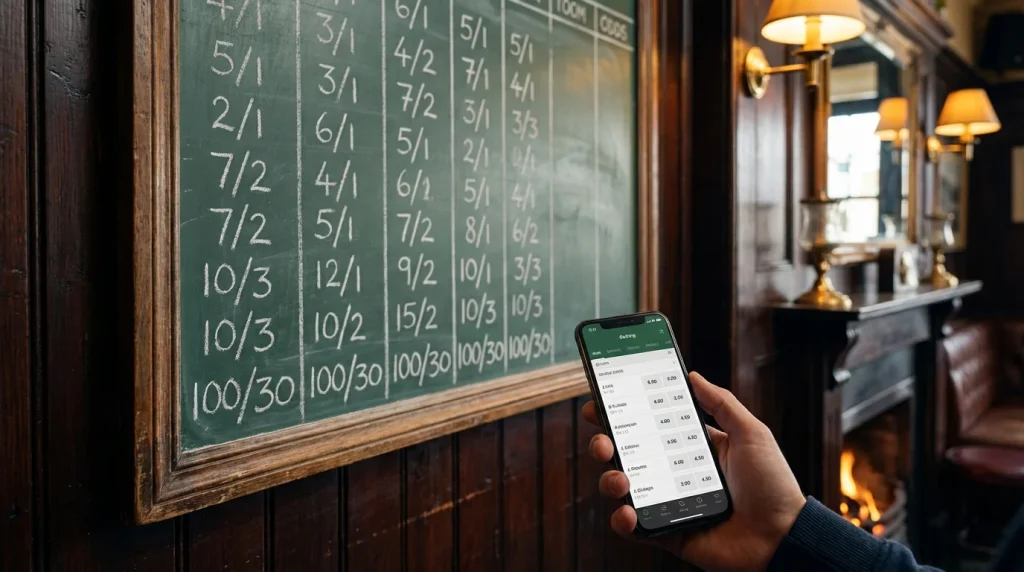
5/1 means five units of profit per one unit staked — but the implied probability is only 16.67%. Fractional odds are the format most UK bettors grew up with, and while they feel intuitive once you are familiar with them, they are arguably the least efficient format for quick mental calculations.
Fractional odds express the profit relative to the stake. At 5/1, a 10-pound stake returns 50 pounds in profit plus the original 10-pound stake, for a total return of 60 pounds. At 1/2 (odds-on), a 10-pound stake returns 5 pounds in profit plus the 10-pound stake, for 15 pounds total. The numerator is the profit; the denominator is the stake. When the numerator is larger (5/1, 10/1, 20/1), the outcome is considered unlikely. When the denominator is larger (1/2, 1/4, 2/7), the outcome is considered likely.
Decimal odds express the total return per unit staked, including the stake itself. The 5/1 fractional price converts to 6.0 in decimal — a 1-pound bet returns 6 pounds total. The 1/2 fractional converts to 1.50 — a 1-pound bet returns 1.50 pounds. The conversion formula from fractional to decimal is: divide the numerator by the denominator and add 1. So 5 divided by 1 equals 5, plus 1 equals 6.0. And 1 divided by 2 equals 0.5, plus 1 equals 1.50. Decimal odds are favoured for comparison and calculation because the arithmetic is simpler — multiplying your stake by the decimal price gives your total return directly.
American odds use a plus/minus system relative to a 100-unit baseline. Positive American odds (like +500) indicate the profit on a 100-unit stake: +500 means 500 units of profit on a 100-unit bet, equivalent to 5/1 fractional or 6.0 decimal. Negative American odds (like -200) indicate the stake required to win 100 units: -200 means you must stake 200 to profit 100, equivalent to 1/2 fractional or 1.50 decimal. Most UK apps include American odds as an option in their settings, but the format is rarely used by UK bettors as a primary display.
Implied probability is the critical concept that connects all three formats to the real world. It answers the question: according to these odds, what is the bookmaker’s assessed probability of this outcome occurring? The formula for decimal odds is simple: 1 divided by the decimal odds, multiplied by 100. At decimal odds of 4.0, the implied probability is 25%. At 2.0, it is 50%. At 1.25, it is 80%. This conversion is the single most useful calculation in betting, because it translates a price into a probability that you can then compare against your own assessment of how likely the outcome actually is.
Most UK betting apps allow you to switch between fractional, decimal, and American formats in the app settings. If you are comfortable with one format and unfamiliar with the others, there is no obligation to switch. But if you intend to compare odds across apps, calculate margins, or assess value, decimal is the most practical format for arithmetic purposes. The industry is gradually moving toward decimal as the default, and younger bettors in the UK increasingly prefer it over fractional for exactly this reason.
The Bookmaker’s Margin — Where the House Edge Lives
A 105% overround means you’re paying 5% for the privilege of betting — and that percentage varies wildly between apps. The bookmaker’s margin, expressed as the overround on a market, is the mechanism that ensures the operator profits over time regardless of individual event outcomes. Understanding it transforms how you evaluate odds.
The overround is calculated by summing the implied probabilities of all outcomes in a market. In a two-outcome market (like a tennis match), convert both decimal prices to implied probabilities and add them. If Player A is priced at 1.80 (implied probability 55.56%) and Player B at 2.10 (47.62%), the total is 103.17%. The true probabilities of all outcomes must sum to exactly 100%. The 3.17% above 100 is the overround — the operator’s margin. Every pound bet on this market contributes approximately 3.17 pence to the operator’s expected profit.
For three-way markets (football match result with home, draw, away), the same method applies with three implied probabilities. Football overrounds on UK apps typically range from 2% on the most competitive Premier League match result markets to 8% or more on lower-league or niche markets. Horse racing win markets carry higher overrounds — 12% to 25% is standard, reflecting the larger number of possible outcomes and the greater pricing uncertainty.
Comparing margins between apps is the most objective way to evaluate odds quality. Two apps may both price Manchester City at 1.50 to beat a relegation rival, but if one app prices the draw at 4.50 and the away win at 7.00, while the other prices the draw at 4.20 and the away win at 6.50, the overrounds will differ — and the app with the lower overround is offering better value across the market as a whole, even if the headline price on one selection appears identical.
In-play margins are consistently wider than pre-match margins. The rapid odds adjustments required during live events, combined with the operator’s risk of being caught on the wrong side of a price change, lead to higher embedded margins. A football match that opens with a 3% overround pre-match may carry a 7% to 10% overround in its live markets. This means that in-play bettors are systematically paying more for the same probability assessment, a cost that is invisible unless you calculate it explicitly.
Reading Between the Odds — How to Spot Value
Value isn’t about picking winners — it’s about finding odds that exceed the true probability. This is the concept that separates strategic betting from gambling on instinct, and it does not require you to predict outcomes correctly every time. It requires you to be right about probability more often than the bookmaker.
A value bet exists when the odds offered by the bookmaker imply a lower probability than the actual probability of the outcome. If you assess a football team’s chance of winning at 60%, the fair decimal odds would be 1.67. If the bookmaker is offering 1.85, the odds imply only a 54% probability — a gap that represents value to you. You could lose this individual bet and it would still have been the right decision, because over hundreds of similar situations, backing outcomes where your assessed probability exceeds the implied probability produces a profit.
The difficulty, of course, is accurately assessing the true probability. Bookmakers employ teams of traders, statistical models, and real-time data feeds to set their odds. A casual bettor with a gut feeling is not operating with the same information advantage. But bookmakers are not infallible, and markets are not always efficient. Odds are influenced by public money flow — when a large volume of bets lands on one side, the bookmaker may shorten those odds to manage liability, even if the probability has not changed. This creates value on the other side of the market for bettors who are not following the crowd.
Line shopping — comparing the same market across multiple apps to find the best available price — is the most practical application of value thinking for recreational bettors. You do not need a statistical model to benefit from it. Simply checking three or four apps before placing a bet and taking the best price ensures that you are not systematically overpaying for the same probability assessment. Over a year of regular betting, line shopping across even two apps can reduce your effective margin cost significantly.
The honest caveat: value betting is a framework, not a guarantee. It requires discipline, consistency, and a willingness to accept short-term losses in pursuit of long-term statistical edges. Most recreational bettors will find that the primary benefit of understanding value is not in generating profit but in making more informed decisions — betting with awareness of what the odds mean, rather than treating them as numbers to react to emotionally. That awareness alone changes the relationship between you and the app from passive consumption to active evaluation, and that shift has value even if it never shows up in your balance.