Gambling Apps With Bet Builder UK
Best Non GamStop Casino UK 2026
Loading...
Bet builder is the feature that turned casual fans into custom odds makers. Before bet builders became standard on UK betting apps, combining multiple selections from the same match into a single bet was either impossible or required contacting the operator directly for a manual price. The technology that enables same-game multiples — calculating the combined probability of correlated outcomes within a single event — has made it possible for any user to construct a personalised bet in under a minute.
The appeal is obvious. Instead of betting on a match result at 2.0, you combine the match result with over 2.5 goals, a specific player to score, and over 9.5 corners, producing combined odds of 15.0 or higher. The bet feels bespoke because it is — you designed it, you selected the legs, and the resulting odds reflect a combination that no standard market offers. Social media has amplified this appeal enormously: bet builder screenshots with eye-catching combined odds circulate widely, creating the impression that big payouts from small stakes are a routine possibility rather than a statistical rarity.
What the screenshots do not show is the margin. Every leg added to a bet builder increases not just the potential payout but also the operator’s embedded edge. Understanding how bet builders are priced, where the margin compounds, and why the feature is one of the most profitable products in a bookmaker’s portfolio is the difference between using the tool with awareness and using it as a slot machine dressed in football.
How Bet Builders Work — Markets, Legs, and Pricing
Adding a second leg to your bet builder doesn’t double the odds — it adds the operator’s correlation margin. The pricing of same-game multiples is fundamentally different from the pricing of traditional accumulators across separate events, and the difference is where the operator makes its money.
In a traditional accumulator spanning independent events — say, three matches on a Saturday afternoon — the combined odds are calculated by multiplying the individual odds together. If each selection is priced at 2.0, the accumulator pays 8.0. The events are independent; the outcome of Match A has no bearing on Match B. The operator’s margin is applied once per leg, and the combined margin is the product of individual margins — significant but predictable.
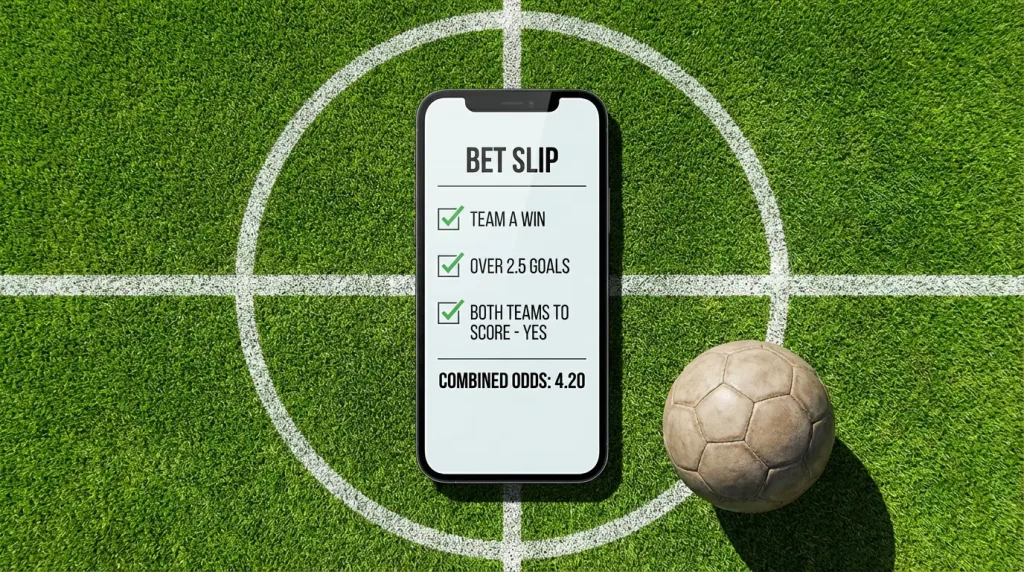
Bet builder legs within a single match are not independent. They are correlated. If you select “over 2.5 goals” and “both teams to score,” those outcomes are positively correlated — a match with over 2.5 goals is more likely than average to feature both teams scoring. If you combine “home team to win” with “under 1.5 goals,” those are also correlated — a low-scoring home win is a specific type of match. The operator must price these correlations, and the correlation model is where the additional margin lives.
The available markets on a bet builder depend on the sport and the operator. For a Premier League football match, a well-equipped bet builder typically offers: match result (1X2), over/under total goals, both teams to score, correct score, first/last/anytime goalscorer, player to receive a card, total corners (over/under), half-time result, and various player-specific markets (shots, shots on target, passes). Some operators extend this to include minute-specific markets (goal in first 10 minutes), team-specific totals (Team A over 1.5 goals), and combinations of player and match events.
Maximum legs vary. Most UK apps allow between 6 and 12 selections in a single bet builder. The upper limit exists partly for technical reasons (the correlation model becomes increasingly complex with more variables) and partly for risk management (a 12-leg bet builder at a 1-pound stake can produce a theoretical payout in the tens of thousands, which the operator must be prepared to honour). Some operators impose maximum payout limits on bet builders that are lower than their standard accumulator limits — a detail worth checking in the terms before constructing a high-odds combination.
The pricing engine recalculates in real time as you add or remove legs. This is one of the more sophisticated pieces of technology in modern sports betting: each addition triggers a reassessment of how the new leg correlates with every existing leg, producing updated combined odds that reflect the full interaction matrix. The speed at which this happens — typically under a second — disguises the computational complexity. The interface makes it feel like you are simply ticking boxes. The mathematics underneath those boxes is anything but simple.
Best UK Apps for Bet Builder Bets
The best bet builder apps offer 12 or more market types per football match — the weakest offer four. Market depth is the single most visible differentiator between bet builder implementations, and it directly determines how creative and specific your bets can be.
For football, which accounts for the overwhelming majority of bet builder activity in the UK, the leading apps provide granular player markets alongside the standard match-level selections. The ability to combine “Player X to score anytime” with “over 10.5 total corners” and “both teams to score in the second half” produces a bet that feels like a detailed match prediction rather than a generic wager. Apps that limit bet builder markets to match result, over/under goals, and both teams to score produce a functional but uninspiring product — the kind of bet builder where every combination feels similar because the available ingredients are too few.
Sport coverage beyond football varies more than you might expect. Some operators offer bet builders on tennis (combining set score, total games, and match winner), basketball (combining player points, total points, and quarter winners), and cricket (combining top batsman, total runs, and match result). Others restrict the feature to football entirely. If you plan to use bet builders on non-football events, verify that the app supports the sport before assuming it does.
Ease of use is the second differentiator. The best bet builder interfaces display available markets in a clean, categorised layout — match markets at the top, player markets below, sorted alphabetically or by popularity. You tap to add a leg, the combined odds update instantly, and conflicting selections (two outcomes that cannot co-exist) are flagged before you submit. The weakest interfaces present markets in a flat, unsorted list that requires scrolling through dozens of options, with conflicting selections only flagged after you attempt to place the bet — a small annoyance that becomes significant when you are building a complex bet under time pressure before kick-off.
Bet builder promotions are common across UK apps. “Bet builder insurance” returns your stake as a free bet if one leg of your builder lets you down. “Odds boosts” enhance the combined price on specific pre-set bet builders. “Bet builder of the day” highlights a curated combination with enhanced odds. These promotions are marketing tools that drive bet builder usage — they do not change the underlying margin structure, but they can add value if the promotional terms are favourable. As with any promotion, the terms determine the value, not the headline.
The Parlay Trap — Why Multi-Leg Bets Favour the Bookmaker
Every leg you add doesn’t just increase your odds — it increases the operator’s edge. This is the mathematical reality that makes bet builders one of the most profitable products for UK bookmakers, and one of the most expensive for the bettors who use them frequently.
The margin compounding works as follows. If the operator applies a 5% margin to each individual market in a bet builder, the combined margin on a four-leg bet is not 20% (4 times 5%). It compounds multiplicatively. The effective overround on a four-leg same-game multiple with 5% margin per leg is approximately 21.5%, meaning the combined odds are roughly 21.5% lower than the true fair value. On a six-leg builder, the effective margin rises to around 34%. On eight legs, it approaches 45%. The more legs you add, the further the combined price drifts from fair value — and the less likely you are to receive a return that compensates for the true probability of the combination winning.
This margin compounding is not unique to bet builders — it applies to all accumulator bets. But bet builders amplify the effect because the correlation margin adds an additional layer on top of the standard per-market margin. When two outcomes are positively correlated, the operator adjusts the combined probability upward (reducing the combined odds) beyond what simple multiplication would produce. When they are negatively correlated, the adjustment goes the other way — but in both cases, the adjustment includes an additional margin buffer that benefits the operator.
The practical implication is not that bet builders should be avoided entirely. They are entertaining, they produce exciting returns when they win, and they allow a level of personalisation that no other bet type offers. The implication is that bet builders should be treated as entertainment bets rather than as a strategy for consistent profit. The margin structure ensures that, over a large number of bet builders, the bettor loses more per pound wagered than on equivalent single bets or on accumulators across independent events.
If you enjoy building custom bets, the most disciplined approach is to set a fixed weekly budget for bet builders — separate from your budget for single bets or standard accumulators — and treat that budget as the cost of entertainment. The joy of watching a four-leg bet builder come in is real. The expectation of it happening regularly is not supported by the maths, and setting your financial expectations accordingly keeps the feature enjoyable rather than frustrating.